

The Vanishing Moderate
A Book Review of Ryan Burge's Latest Work

This past December, on Christmas Eve, I found myself surrounded by a very unusual gathering of people. Among the faithful and somewhat faithful that night were individuals spanning the entire US political spectrum. Behind me, a couple I know who strongly support the current president; across the aisle, someone I’ve seen at local resistance rallies; two rows back, a middle-aged man who regrets his 2024 vote; and next to him, a young woman who despises politics and just wants a better job. Why is this unusual? According to author Ryan Burge, the so-called moderate congregation is being hollowed out, and that’s a problem for both religion and politics.
When I served in ministry, I often told people that the US congregation, especially in the mainline tradition, might be that one place where people can engage across their differences. Organizations like Braver Angels have promoted this work for decades. However, Burge, author of the new book The Vanishing Church, argues that moderate congregations are becoming increasingly rare. I should note that by moderate, he means—and I agree—that these are not places of muddle or mush. Rather, they are salad bowls of the full spectrum of opinions.
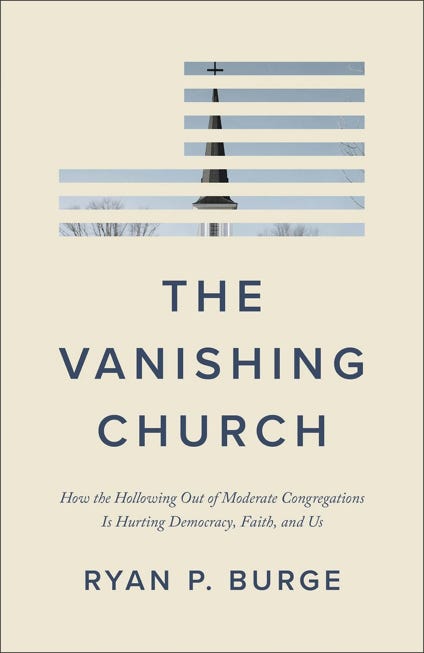
Burge’s research is thorough and aligns with other recent studies on the decline of religious participation in America. I found this book easier to read than Christian Smith’s Why Religion Went Obsolete. While Smith explores every possible cultural change in America since the 1960s, Burge keeps his focus tightly on congregational life. He also shares personal anecdotes, including the story of a congregation he served, loved, but eventually had to close due to a lack of members.
Like many analyses of American religion, Burge’s analysis is clear. Specifically, the middle way is struggling in American society these days. Christianity, but also Judaism and Islam, tend to lean two ways — more to the right and to the left. Finding a place that wants to engage with people of varied backgrounds is increasingly rare. This makes it difficult for those who want to have civil discussions about the challenges we face as a democracy in a faith-based context.

What I found particularly insightful from Burge is his clear explanation that people’s political views are no longer influenced by religion. Instead, they are shaped by political ideology. This became clear years ago when a pastor I knew shared a conversation he had with a woman in his church. She was upset with his preaching, saying it was too political. They discussed it for a while, and then he asked her to read a portion of Jesus’ Sermon on the Mount. Afterwards, she paused and said, “Oh my, I realize it’s not you I disagree with, it’s Jesus.” Increasingly, people are letting politics shape all aspects of their lives.
Burge concludes his book with some hopeful observations. First, he states that most Americans are pragmatic and moderate in their views, backed by supporting data. However, the problem is that they have adopted a “go along to get along” attitude. In other words, moderates might be the majority, but they are not speaking up, leaving the public square open to be dominated by extremes. Second, he argues that a common issue among more nuanced individuals in our country is our addiction to perfection. The saying, “perfection is the enemy of the good,” is far too influential. Finally, he encourages people to remember the phrase, “don’t dehumanize the other.” This means recognizing that, despite disagreements with someone who proudly wears a MAGA hat or loudly chants at an opposition rally, those are still people. They probably formed their beliefs based on their experiences, context, or life events. Yes, we are all influenced by our media choices, but beneath each person is a narrative that explains their belief system. That could be the starting point for conversations across differences. Instead of challenging the other’s beliefs directly, a better approach might be to ask, “Tell me how you came to believe that way.”
Burge has written a helpful book and offers a hopeful view that a moderate approach can be revived. I cling to his optimism, but I’ll also approach it with the kind of Christian realism I wrote about last week.
More to Come,

James Hazelwood writes about culture, religion, politics and the inner workings of the human soul. He also makes beds, does dishes and shovels snow in Rhode Island www.jameshazelwood.net
Thank you so much for clarity and for considerateness. To ask another the question of how they come to believe a particular philosophy is a loving kindness. To listen deeply and tenderly to their response, though sometimes difficult, is the path to world peace.